

Market Research Industry Today
Weather Forecasting Services Business Plan Template: Pricing Models, Technology, & Risk Management
Weather Forecasting Services Business Plan Overview:
Starting a weather forecasting services business offers strong opportunities for organizations aiming to provide accurate, real-time meteorological insights for agriculture, aviation, marine operations, logistics, energy, construction, and disaster management. A well-structured Weather Forecasting Services Business Plan ensures streamlined data collection, advanced forecasting models, and reliable service delivery. Success in this industry depends on scientific accuracy, technological efficiency, and the ability to help clients make informed decisions and minimize weather-related risks.
Exploring the Weather Forecasting Services Industry:
The weather forecasting industry is expanding rapidly due to climate change, rising demand for risk management solutions, and increased reliance on weather data across multiple sectors. Clients depend on forecasting providers for hyperlocal predictions, extreme weather alerts, climate analytics, and long-term environmental trends. Advancements in satellite imaging, radar systems, IoT weather sensors, artificial intelligence, and numerical weather prediction (NWP) models are transforming forecasting accuracy and speed. Growing emphasis on early warning systems, smart agriculture, and climate resilience fuels demand for professional weather forecasting services.
See the Data First: Download Your Sample Report: https://www.imarcgroup.com/weather-forecasting-services-business-plan-project-report/requestsample
Is weather forecasting services business profitable?
Yes, the weather forecasting services business is profitable due to rising demand for real-time weather data, climate insights, and risk mitigation solutions. Industries such as agriculture, aviation, renewable energy, transportation, and retail rely heavily on accurate forecasts. Businesses can generate revenue through subscription models, data licensing, customized alerts, consulting services, and analytics platforms, ensuring scalable and recurring income.
Global Weather Forecasting Services Market Overview:
The global weather forecasting services market reached USD 2.5 Billion in 2025, and IMARC Group projects it will grow to USD 4.7 Billion by 2034, registering a CAGR of 7.17% from 2026–2034. North America leads the market with over 28.9% share in 2025, driven by advanced technological adoption, growing climate variability, significant government investments, and increasing demand for precise weather data across industries such as aviation, agriculture, energy, and transportation.
Market Trends and Opportunities:
Technology, digital transformation, and climate adaptation policies are creating significant opportunities for weather forecasting service providers. AI-enabled forecasting models, machine learning–based climate analysis, and IoT sensor networks enhance data precision. Demand from sectors like agriculture, maritime operations, renewable energy, and insurance continues to grow. Offering tailored services such as hyperlocal forecasts, seasonal climate predictions, drought monitoring, and severe weather alerts helps companies differentiate and secure long-term contracts.
Types of Weather Forecasting Services:
Weather forecasting companies typically offer a wide range of specialized services. These include short-term and long-term forecasts, real-time alerts, climate risk assessments, atmospheric modeling, and seasonal predictions. Additional services may include aviation weather briefings, marine weather routing, agri-weather advisory, flood forecasting, and custom climate analytics. Businesses may also offer IoT-based weather monitoring, energy demand forecasting, and environmental impact reports to serve diverse industries effectively.
How to Launch Your Weather Forecasting Services Business:
Launching your weather forecasting business begins with defining your target clients, service offerings, and technical capabilities. Select a location equipped with advanced computing infrastructure, weather instruments, and high-speed data connectivity. Essential investments include weather stations, meteorological sensors, satellite data subscriptions, radars, forecasting software, and cloud computing tools.
Building a skilled team of meteorologists, data scientists, climate analysts, and system engineers ensures high-quality forecasting and analysis. Establishing structured workflows supports accuracy, consistency, and scalability.
Creating a Business Plan:
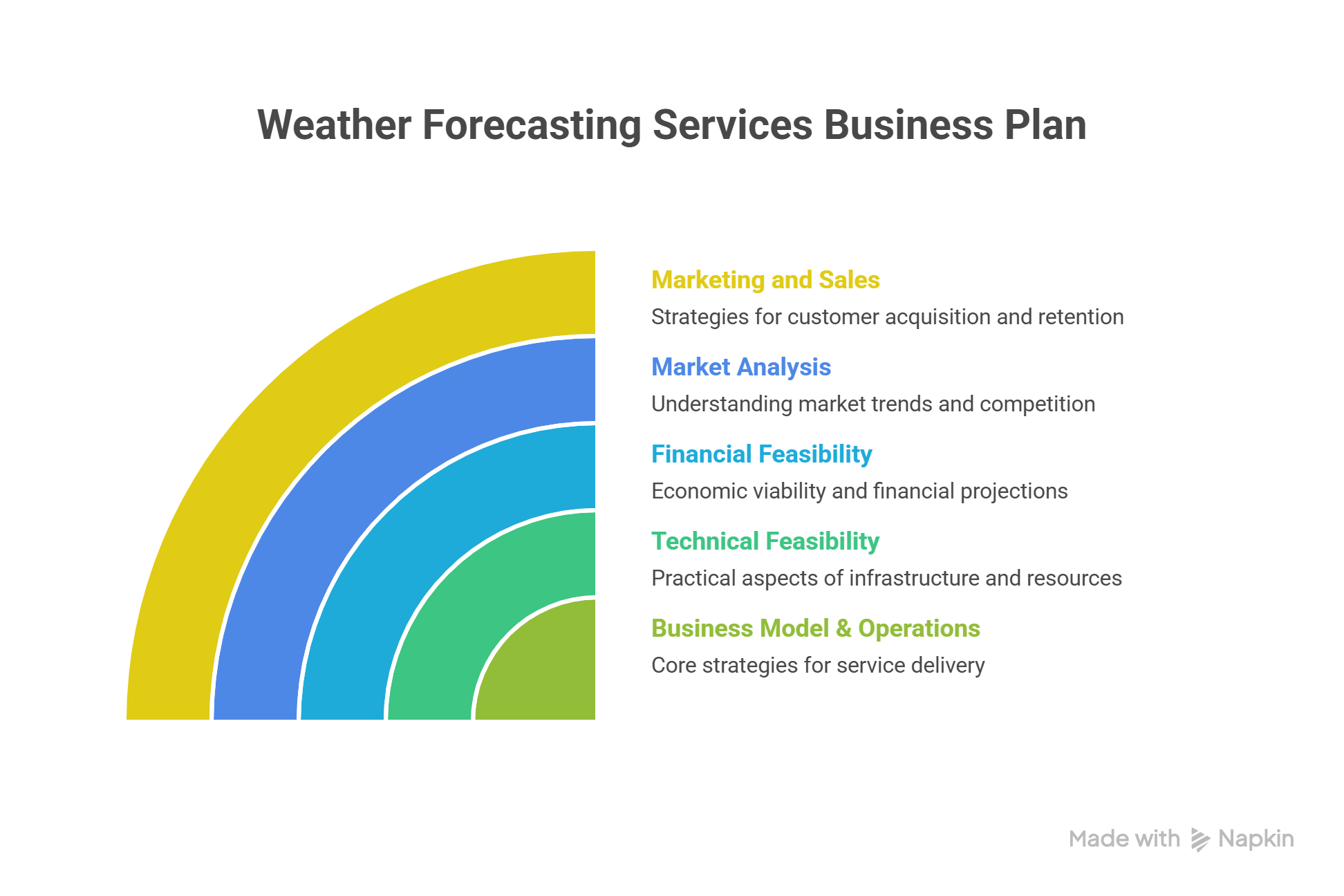
A structured Weather Forecasting Services Business Plan should include market research, operational frameworks, technology planning, and financial projections. Identify industries you intend to serve and evaluate their weather dependency. Document the forecasting workflow, including data collection, model interpretation, quality assurance, alert dissemination, and client reporting. Financial planning should outline startup equipment costs, data acquisition expenses, staffing, expected revenue streams, and break-even timelines.
Book a Session with Our Analyst to Optimize Your Business Plan Report: https://www.imarcgroup.com/request?type=report&id=44524&flag=C
Securing Funding and Resources:
Funding options include government grants, climate-tech investment, business loans, and partnerships with meteorological agencies. Presenting a well-developed business plan that highlights rising demand for climate intelligence strengthens funding potential. Allocate financial resources toward equipment, data subscriptions, forecasting software, skilled personnel, and marketing activities. Effective resource and financial planning ensure efficient operations and reliable forecasting services.
Legal and Regulatory Requirements:
Operating a weather forecasting business requires compliance with national meteorological guidelines, data-sharing regulations, and communication protocols for public warnings. Some jurisdictions require licensing or collaboration with official meteorological departments. Ensuring secure data handling, user privacy, and ethical use of climate information is essential. Following accuracy standards and maintaining proper documentation enhances credibility and regulatory compliance.
Strategies for Managing and Growing Your Business:
Growth depends on the accuracy of forecasts, timely service delivery, and strong client relationships. Invest in high-performance computing systems, improved forecasting algorithms, and real-time data integration tools. Implement strict quality assurance processes, including model validation, cross-checking with satellite data, and performance monitoring. Offering additional services such as climate consulting, risk modeling, agricultural decision support tools, and custom dashboards strengthens your competitive edge. Continuous innovation ensures long-term industry relevance.
Operational Efficiency and Project Management:
Efficient operations ensure reliable forecasting and timely updates. Standardizing processes for data collection, analysis, alert generation, and client reporting improves reliability. Using project management platforms and automated alert systems enhances workflow transparency and responsiveness. Defined workflow stages—data acquisition, model processing, interpretation, quality check, and dissemination—support accuracy and client satisfaction.
Marketing and Customer Acquisition:
A strong marketing strategy helps attract businesses, government agencies, and organizations seeking weather insights. Develop a professional website showcasing your forecasting capabilities, industry expertise, data tools, and sample reports. Utilize SEO to target weather forecasting, climate analytics, and industry-specific weather advisory keywords. Participate in climate conferences, agriculture expos, aviation events, marine exhibitions, and government programs to increase visibility. Offering free demo forecasts, trial subscriptions, and tailored solutions improves client engagement and conversion.
Scaling and Expansion:
Expansion opportunities include adding advanced weather stations, developing mobile forecasting apps, offering global climate insights, and integrating predictive analytics tools. Expanding into international markets, collaborating with research institutes, and licensing weather data to third-party platforms strengthen business scalability. Introducing sector-specific forecasting solutions—such as renewable energy forecasting or disaster response tools—further enhances long-term growth.
Key Takeaways for Success:
A well-prepared Weather Forecasting Services Business Plan provides a strong foundation for entering the climate intelligence industry. Prioritizing accuracy, technology, and reliable service delivery builds a strong competitive advantage. Skilled meteorologists, advanced tools, and scalable workflows support consistent performance. Effective marketing, service diversification, and continuous innovation ensure long-term success and business growth.
IMARC’s Support for Weather Forecasting Services Businesses:
IMARC provides comprehensive support for launching and scaling a weather forecasting services business by offering detailed market insights, feasibility studies, financial projections, operational guidance, and strategic recommendations. Their expertise helps you evaluate viability, secure funding, optimize operations, and build a profitable, future-ready weather services venture.
Get Instant Access Now: https://www.imarcgroup.com/checkout?id=44524&method=2142
What We Provide:
• Weather forecasting market research and feasibility studies
• Operational and technical workflow optimization
• Equipment, sensor, and software selection guidance
• Financial projections and cost analysis
• Industry benchmarking and competitive assessment
• Staffing and training roadmap
• Marketing and customer acquisition strategies
• Regulatory compliance and data governance support
About Us:
IMARC Group is a leading global market research and management consulting firm. We specialize in helping organizations identify opportunities, mitigate risks, and create impactful business strategies.
Contact Us:
IMARC Group
134 N 4th St., Brooklyn, NY 11249, USA
Email: sales[@]imarcgroup.com
Tel No:(D) +91 120 433 0800
United States: (+1-201971-6302)
Share on Social Media


Contact Information
IMARC Group
134 N 4th St.
Brooklyn
New York
11249
+1-201-971-6302
https://www.imarcgroup.com
Other Industry News
Ready to start publishing
Sign Up today!



