Market Research Industry Today
Europe Wireless Audio Device Market: Growth, Trends, and Future Outlook to 2032
The rapid evolution of consumer electronics and digital entertainment ecosystems has transformed how people experience sound. Wireless audio devices have become essential components of modern lifestyles, enabling seamless connectivity, portability, and enhanced listening experiences across multiple environments. In Europe, the demand for wireless audio technologies has grown significantly due to increasing smartphone adoption, smart home integration, and the rising popularity of streaming services. According to industry research, the Europe wireless audio device market is projected to reach USD 17.74 billion by 2032, growing from USD 13.28 billion in 2025 at a CAGR of 4.2% during the forecast period.
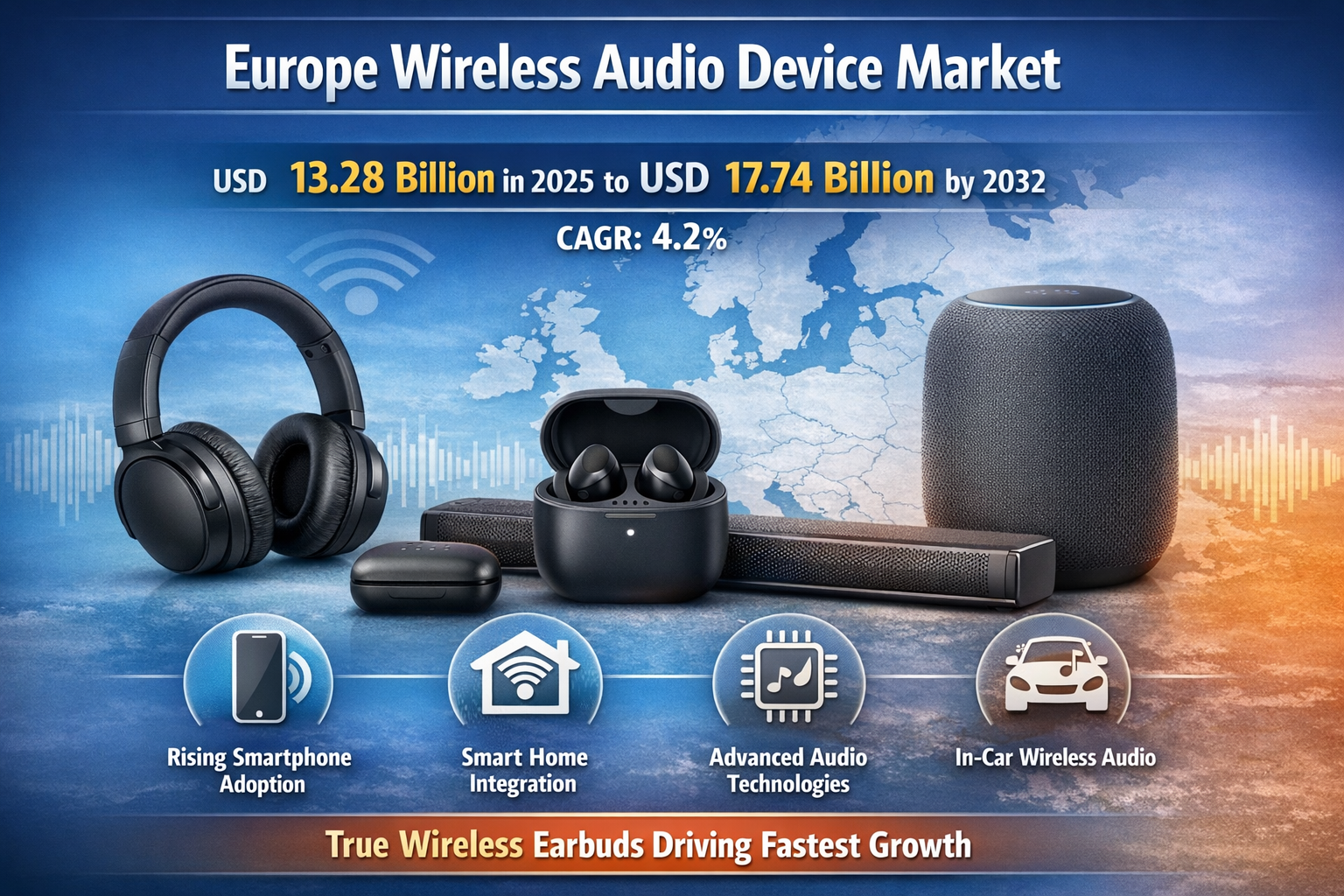
This steady expansion is driven by technological innovation, consumer lifestyle changes, and the increasing integration of wireless audio solutions in automotive, consumer electronics, and professional environments. As wireless connectivity technologies such as Bluetooth, Wi-Fi, and radio frequency continue to improve, wireless audio devices are becoming more efficient, intelligent, and widely adopted across Europe.
Download PDF Brochure:
https://www.marketsandmarkets.com/pdfdownloadNew.asp?id=1275
Understanding Wireless Audio Devices
Wireless audio devices are electronic products that transmit or receive audio signals without the use of physical cables. These devices rely on wireless technologies such as Bluetooth, Wi-Fi, and radio frequency to deliver high-quality audio across various applications. Examples include wireless headphones, true wireless earbuds, speakers, soundbars, and headsets used in both consumer and enterprise settings.
The shift toward wireless technologies reflects consumers’ growing preference for mobility, convenience, and clutter-free environments. From listening to music during workouts to participating in remote meetings or enjoying immersive home entertainment systems, wireless audio devices have become integral to daily life.
Market Size and Growth Outlook
The European wireless audio device market has shown consistent growth over the past decade due to increasing digitalization and the widespread use of connected devices. The market was valued at approximately USD 12.62 billion in 2024 and is expected to reach USD 17.74 billion by 2032, reflecting a healthy growth trajectory for the industry.
Several macroeconomic and technological factors contribute to this expansion:
- Rapid growth in smartphone penetration
- Increasing popularity of wireless entertainment devices
- Growth in remote work and digital collaboration tools
- Expansion of smart homes and IoT ecosystems
- Advancements in wireless connectivity technologies
Additionally, European consumers increasingly prioritize premium audio experiences, driving demand for high-quality wireless headphones, speakers, and earbuds equipped with advanced sound technologies.
Key Market Drivers
Rising Demand for True Wireless Earbuds and Headphones
One of the most significant growth drivers in the European wireless audio market is the surge in demand for true wireless stereo (TWS) earbuds and wireless headphones. These devices offer portability, long battery life, and enhanced features such as active noise cancellation and voice assistant integration.
Consumers increasingly prefer wireless earbuds because they provide a convenient listening experience during commuting, workouts, and remote work. The removal of headphone jacks in many smartphones has also accelerated the adoption of wireless alternatives. As a result, the true wireless earbuds segment is expected to record the highest CAGR of approximately 5.4% during the forecast period.
The demand for wireless headphones is also fueled by increased usage of online streaming platforms, gaming services, and digital content consumption.
Expansion of Smart Home Ecosystems
Smart homes are becoming increasingly common across Europe. Devices such as smart speakers, connected TVs, and voice assistants rely heavily on wireless audio technologies to deliver immersive sound experiences.
Wireless speakers and soundbars are widely used in home entertainment systems to provide multi-room audio and seamless integration with smart home platforms. Consumers are adopting these devices to enhance their living spaces with advanced entertainment capabilities and voice-controlled audio systems.
Growth of Remote Work and Hybrid Work Models
The shift toward remote and hybrid work environments has created new demand for high-quality wireless audio devices. Professionals require reliable headsets and earbuds for virtual meetings, online collaboration, and remote communication.
Wireless headsets equipped with noise cancellation, voice clarity enhancements, and long battery life are increasingly used by employees working from home or traveling for business. This trend is expected to continue as organizations embrace flexible working models across Europe.
Increasing Use of Wireless Audio in Automotive Systems
Another important growth driver for the European wireless audio device market is the rapid evolution of in-vehicle infotainment systems. Automakers are integrating advanced wireless audio technologies to enhance the driving experience.
Wireless speakers, hands-free calling systems, and voice-controlled entertainment platforms are becoming standard features in modern vehicles. The transition toward connected and electric vehicles has further accelerated the adoption of wireless audio solutions within automotive ecosystems.
Regulations restricting the use of handheld mobile devices while driving are also encouraging drivers to rely on hands-free wireless audio systems for navigation, communication, and entertainment.
As a result, the automotive segment is expected to be one of the fastest-growing application areas for wireless audio technologies in Europe.
Technological Trends Shaping the Market
Bluetooth Dominance
Bluetooth remains the most widely used technology in wireless audio devices due to its compatibility with smartphones, laptops, and other consumer electronics. The Bluetooth segment is projected to hold the largest market share in Europe because of its low power consumption and easy integration with portable devices.
Recent advancements in Bluetooth technology, such as Bluetooth Low Energy (LE) Audio and multi-stream audio capabilities, have significantly improved sound quality, latency, and energy efficiency.
Artificial Intelligence in Audio Processing
Artificial intelligence is playing an increasingly important role in modern wireless audio devices. AI-powered audio processing technologies enable features such as adaptive noise cancellation, automatic sound optimization, and personalized listening experiences.
AI algorithms analyze environmental sounds and user preferences to adjust audio output in real time, providing improved clarity and immersive listening experiences.
Spatial Audio and Immersive Sound
Spatial audio technology is becoming a key differentiator in premium wireless audio devices. This technology creates a three-dimensional sound environment that enhances music, gaming, and movie experiences.
By simulating sound direction and depth, spatial audio allows listeners to experience sound as if it is coming from multiple directions, significantly improving audio immersion.
Integration with Health and Fitness Technologies
The growing focus on health and wellness in Europe has created opportunities for wireless audio devices equipped with biometric sensors and fitness tracking features.
Smart earbuds can monitor heart rate, activity levels, and workout performance while providing real-time coaching through voice feedback. This integration of audio technology with wearable health monitoring systems is expected to expand significantly in the coming years.
Market Challenges
Despite its strong growth potential, the Europe wireless audio device market faces several challenges that may hinder its expansion.
Regulatory Constraints
Wireless audio devices must comply with strict radio frequency regulations established by European authorities. Compliance with these standards can increase development costs and delay product launches for manufacturers.
Audio Quality Limitations
Although wireless technologies have improved significantly, achieving high-fidelity sound transmission remains challenging. Bandwidth limitations, codec constraints, and latency issues can sometimes reduce audio quality compared to wired systems.
Manufacturers must continue investing in advanced compression technologies and improved wireless protocols to overcome these limitations.
Market Segmentation
The Europe wireless audio device market can be segmented based on product, technology, functionality, and application.
By Product
- Headphones
- Wireless speakers
- True wireless earbuds/hearables
Among these, true wireless earbuds are expected to dominate due to their portability and compatibility with modern smartphones.
By Technology
- Bluetooth
- Wi-Fi
- Radio Frequency
Bluetooth currently leads the market due to its widespread adoption in consumer electronics.
By Functionality
- Smart devices
- Non-smart devices
Smart devices integrated with AI, voice assistants, and IoT connectivity are expected to witness faster adoption.
By Application
- Consumer electronics
- Automotive
- Professional and enterprise use
The consumer segment accounts for the largest share because of increasing demand for personal entertainment devices.
Regional Insights: Germany Leading the Market
Within Europe, Germany is expected to dominate the wireless audio device market due to its strong consumer electronics industry, high purchasing power, and widespread adoption of premium audio technologies.
The country also benefits from a large base of technology-savvy consumers and strong presence of global audio brands. Other key markets in Europe include the United Kingdom, France, Italy, and Spain, where demand for smart home entertainment systems and wireless headphones continues to grow.
Competitive Landscape
The European wireless audio device market is highly competitive, with several global and regional companies offering innovative products. Leading companies focus on product innovation, ecosystem integration, and strategic partnerships to strengthen their market position.
Key players in the market include:
- Apple Inc.
- HARMAN International
- Sony Group Corporation
- Sonos Inc.
- Masimo Corporation
- Bose Corporation
- Sennheiser electronic SE & Co. KG
- Marshall Group AB
- Yamaha Corporation
- LG Electronics
These companies invest heavily in research and development to introduce advanced features such as spatial audio, AI-driven sound optimization, and improved battery performance.
Future Outlook
The future of the Europe wireless audio device market looks promising as technological advancements continue to reshape the audio industry. The convergence of artificial intelligence, wireless connectivity, and smart device ecosystems will create new opportunities for innovation.
Emerging technologies such as augmented reality (AR), virtual reality (VR), and immersive gaming platforms will further increase the demand for high-performance wireless audio devices. Additionally, the expansion of 5G networks and smart city infrastructure will enable faster and more reliable audio connectivity across Europe.
Manufacturers are also expected to focus on sustainability by developing eco-friendly materials, energy-efficient components, and recyclable packaging for wireless audio products.
The Europe wireless audio device market is undergoing a transformation driven by digital innovation, changing consumer lifestyles, and advancements in wireless connectivity. With the market expected to reach nearly USD 17.74 billion by 2032, wireless audio technologies will continue to play a critical role in shaping the future of entertainment, communication, and smart living environments.
Growing demand for true wireless earbuds, the expansion of smart homes, and the integration of wireless audio in automotive and professional applications will sustain market growth in the coming years. As companies invest in next-generation audio technologies and AI-powered sound processing, the European wireless audio ecosystem will become more immersive, intelligent, and interconnected.
Share on Social Media


Contact Information
SAMIR SHUKLA
MarketsandMarkets™ Research Private Ltd.
Magarpatta Sez, Tower B5-1
Hadapsar
Pune
Maharashtra
411013
9923490533
https://www.marketsandmarkets.com/
Other Industry News
Ready to start publishing
Sign Up today!