

Market Research Industry Today
Delirium Treatment Drugs Market Competition Ranking, Market Size, Market Share, Forecast Report 2026-2032
Global Info Research has recently published "Global Delirium Treatment Drugs Market 2026 by Manufacturers, Regions, Type and Application, Forecast to 2032". This report systematically analyzes the current status, future trends (2021-2032), and competitive landscape of the global Delirium Treatment Drugs market. It provides a quantitative analysis from the perspectives of type (Oral、 Injection、 Others), application (Hospitals、 Clinics), regional markets, and major manufacturers (Mylan N.V.、 Pfizer Inc.、 Novartis AG、 Gala BioPharma Ltd.、 Teva pharmaceuticals、 Dr Franz Kohler Chemie GmbH、 Bristol-Myers Squibb、 Regenstrief Institute Inc、 Fraser Health、 Otsuka Pharmaceutical Co. Ltd.、 Zydus Cadila), comprehensively assessing market opportunities and competitive dynamics.
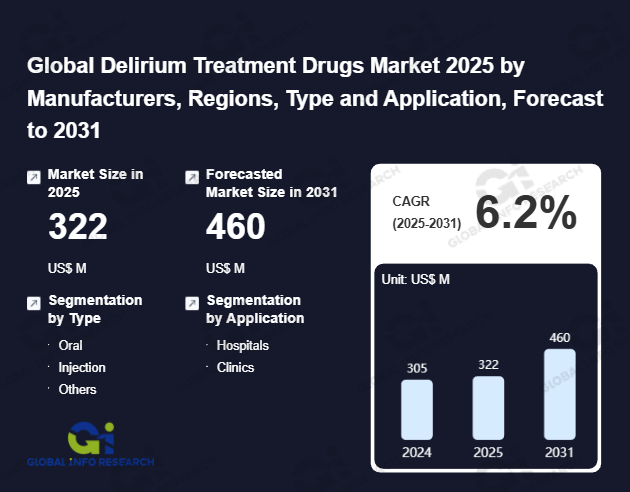
The core insights of this report on the global Delirium Treatment Drugs market (2021-2032) are as follows:
Analysis Scope: Covers market status, future trends, and competitive landscape.
Key Dimensions: Quantitative assessment from the perspectives of type (Oral、 Injection、 Others), application (Hospitals、 Clinics), global regional markets, and major manufacturers (Mylan N.V.、 Pfizer Inc.、 Novartis AG、 Gala BioPharma Ltd.、 Teva pharmaceuticals、 Dr Franz Kohler Chemie GmbH、 Bristol-Myers Squibb、 Regenstrief Institute Inc、 Fraser Health、 Otsuka Pharmaceutical Co. Ltd.、 Zydus Cadila).
Core Conclusion: Systematically analyzes Delirium Treatment Drugs market opportunities and overall competitive landscape.
The following is a chapter-by-chapter breakdown of the Delirium Treatment Drugs report:
Part 1: Research Framework and Market Overview (Chapter 1)
This chapter is the foundation of the report, aiming to define the research scope, define the market, and outline the global overview.
1. Definitions and Statistical Notes: Clearly defines the industry scope of "Delirium Treatment Drugs" and explains the statistical caliber and methodology for market size (revenue), ensuring data comparability.
2. Establishment of Market Segmentation Standards:
By Type: Divides types into Oral、 Injection、 Others, and compares the size of each type in the global market at different time points (2021, 2025, 2032).
By Downstream Application: Focuses on end-use areas such as Hospitals、 Clinics, and compares the historical and future market size of each area.
3. Global and Regional Size Overview:
Presents the overall historical data and forecasts of the global Delirium Treatment Drugs market from 2021 to 2032.
Shows the Delirium Treatment Drugs market size and forecasts by region (North America, Europe, Asia Pacific, South America, Middle East and Africa), with particular emphasis on the growth potential of the Asia Pacific region (especially China), laying the foundation for subsequent in-depth regional analysis.
Part 2: In-depth Analysis of the Competitive Landscape (Chapters 2-3)
This is the core component of the report, focusing on analyzing the market participants in the Delirium Treatment Drugs market.
1. In-depth Profiles of Major Delirium Treatment Drugs Manufacturers (Chapter 2): Provides a detailed introduction to leading global Delirium Treatment Drugs manufacturers (such as Mylan N.V.、 Pfizer Inc.、 Novartis AG、 Gala BioPharma Ltd.、 Teva pharmaceuticals、 Dr Franz Kohler Chemie GmbH、 Bristol-Myers Squibb、 Regenstrief Institute Inc、 Fraser Health、 Otsuka Pharmaceutical Co. Ltd.、 Zydus Cadila, etc.). Content includes:
Company background and main business.
Introduction to the Delirium Treatment Drugs offered.
Key financial and market data: service revenue, gross profit margin, and market share from 2021-2026.
Latest developments of manufacturers, providing insights into strategic trends.
2. Quantitative Analysis of the Global Competitive Landscape (Chapter 3):
Lists the revenue ranking of major global Delirium Treatment Drugs manufacturers.
Calculates and analyzes the market concentration of Delirium Treatment Drugs (market share of the Top 3 and Top 5), assessing the degree of market monopoly or competition.
Analyzes manufacturers' product portfolios and key downstream markets, revealing their strategic focus.
Summarizes mergers and acquisitions, new entrants, and capacity expansion in the Delirium Treatment Drugs industry, reflecting market activity and competitive changes.
Part 3: Quantitative Forecast of Segmented Markets (Chapters 4-5)
After establishing the competitive landscape, the report provides independent, quantitative scale forecasts for two segmented dimensions.
1. Different Market Types (Chapter 4): Forecasts the revenue, growth trends, and market share changes of Oral、 Injection、 Others from 2021-2032, identifying future product trends.
2. Different Application Markets (Chapter 5): Forecasts the revenue, growth trends, and market share changes of applications such as Hospitals、 Clinics from 2021-2032, identifying demand in downstream markets.
Part 4: In-depth Scan of Major Global Regional Markets (Chapters 6-10)
This is another core part of the report, breaking down the global Delirium Treatment Drugs market into specific regions and countries for a three-dimensional analysis.
Each regional chapter (North America, Europe, Asia Pacific, South America, Middle East & Africa) has a consistent structure:
1. Intra-regional analysis: Market revenue and forecasts for different types and applications within the region.
2. Analysis of key countries:
Lists the market size (revenue) of major countries in the region. Separate market size forecasts are provided for key countries (e.g., the US, Canada, Mexico; Germany, France, UK, China, Japan, South Korea, India, ASEAN, etc.).
Value: Helps readers understand the mainstream types, dominant application industries, and specific market capacity of Delirium Treatment Drugs in specific regions (such as Asia Pacific) or countries (such as China).
Part 5: Market Dynamics and Industry Chain Analysis (Chapters 11-12)
This section aims to explain "why" and "how" the Delirium Treatment Drugs market develops.
1. Market Dynamics (Chapter 11):
Drivers and Restraints: Systematically analyzes the key forces that promote and inhibit the growth of the Delirium Treatment Drugs industry.
Development Trends: Reveals the future direction of changes in technology, service models, or customer needs.
Porter's Five Forces Analysis: Systematically assesses the competitive intensity and attractiveness of the Delirium Treatment Drugs industry from five perspectives: industry competition, potential entrants, supplier bargaining power, buyer bargaining power, and threat of substitutes.
2. Industry Chain Analysis (Chapter 12):
Outlines the complete chain of the Delirium Treatment Drugs industry's upstream (raw material suppliers), midstream (manufacturers themselves), and downstream (application industries).
Analyzes the connections and value distribution of each link to understand the ecosystem of the Delirium Treatment Drugs industry.
Part Six: Conclusions and Appendix (Chapters 13-14)
1. Research Conclusions (Chapter 13): Summarizes the core findings of the entire report, extracting key conclusions about the Delirium Treatment Drugs market size, growth points, competitive landscape, segmented market opportunities, and regional prospects.
2. Appendix (Chapter 14):
Research Methodology: Explains the research methods used in the report (e.g., secondary research, model forecasting, etc.).
Data Sources: Ensures the transparency and traceability of the research.
Disclaimer: Clarifies the limitations of the report data.
To read the full report or request a free sample report, please use the link: https://www.globalinforesearch.com/reports/2918639/delirium-treatment-drugs
Summary of the Report's Core Value:
This report not only provides detailed quantitative data (historical and forecast) on the global Delirium Treatment Drugs market, but also constructs a three-dimensional Delirium Treatment Drugs market analysis framework through multi-dimensional cross-analysis (manufacturer x product x application x region). It not only answers the question of "how big is the market," but also provides in-depth answers to strategic questions such as "who are the competitors," "where are the opportunities," and "where is the future headed," offering highly practical decision-making references for market entrants, investors, industry participants, and brands.
This article is excerpted from "Global Delirium Treatment Drugs Market 2026 by Manufacturers, Regions, Type and Application, Forecast to 2032," published by Global Info Research. It deeply analyzes the Delirium Treatment Drugs market using professional market research methods and provides an in-depth analysis of the impact of US tariff policies and various countries' countermeasures on Delirium Treatment Drugs market competitors, including regional economic performance and supply chains.
Related Reports Recommended:
Global Delirium Treatment Drugs Supply, Demand and Key Producers, 2025-2031
[Company Introduction] Global Info Research is a comprehensive market research institution with a global perspective and a focus on value insights. Since its establishment, the company has always adhered to the core philosophy of "Global Positioning, Value Convergence," focusing on providing accurate, in-depth, and actionable industry analysis and strategic decision-making support for global manufacturers, investment institutions, and government departments. We are committed to becoming a wise partner for our clients in seizing opportunities and meeting challenges in the global business environment.
[Contact Us]
Email: report@globalinforesearch.com
Chinese Website: https://www.globalinforesearch.com.cn
English Website: https://www.globalinforesearch.com
Share on Social Media


Contact Information
lee Mike
MARKET RESEARCH REPORT STORE, INC.
17890 Castleton Street Suite 369 City of Industry CA 91748 US
Los Angeles
CA 91748
https://www.globalinforesearch.com/

Other Industry News
Ready to start publishing
Sign Up today!



