Market Research Industry Today
3D Cell Culture Clearing Reagent Market: Sales Volume, Size, Share, Price Development Trend Forecast Report
3D Cell Culture Clearing Reagent is a chemical treatment solution specifically designed for three-dimensional culture models (such as organoids and tumor spheroids). Its core function is to reduce the refractive index difference between biological tissue and the surrounding medium, enabling photons to penetrate the sample efficiently, thus making the originally opaque, thick three-dimensional biological structure optically transparent. This reagent typically consists of a specific ratio of detergent, hydration agent, and refractive index-matching medium, capable of removing light-scattering substances such as lipids without severely damaging the endogenous fluorescent protein signals and morphological structures of the sample. Using this reagent, researchers can combine confocal, light-sheet, or two-photon imaging techniques to achieve high-resolution visualization of the spatial distribution, interactions, and signaling pathway activities of cells in 3D culture models, greatly advancing the fields of developmental biology, disease mechanism research, and drug screening.
According to the new market research report “Global 3D Cell Culture Clearing Reagent Market 2025 by Manufacturers, Regions, Type and Application, Forecast to 2031”, published by Global Info Research, the global 3D Cell Culture Clearing Reagent market size was valued at US$ 99 million in 2024 and is forecast to a readjusted size of USD 171 million by 2031 with a CAGR of 8.7% during review period.
Figure. Global 3D Cell Culture Clearing Reagent Market Size (US$ Million), 2020-2031
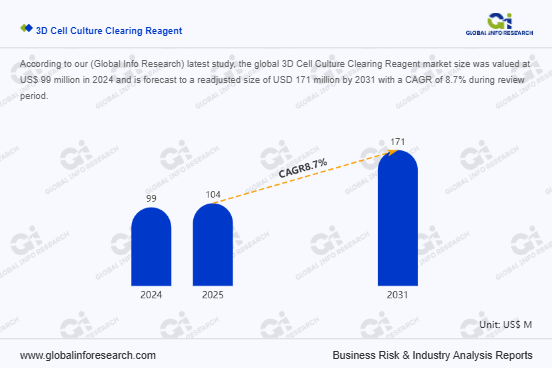
Figure. Global 3D Cell Culture Clearing Reagent Top 10 layers Ranking and Market Share (Ranking is based on the revenue of 2024, continually updated)
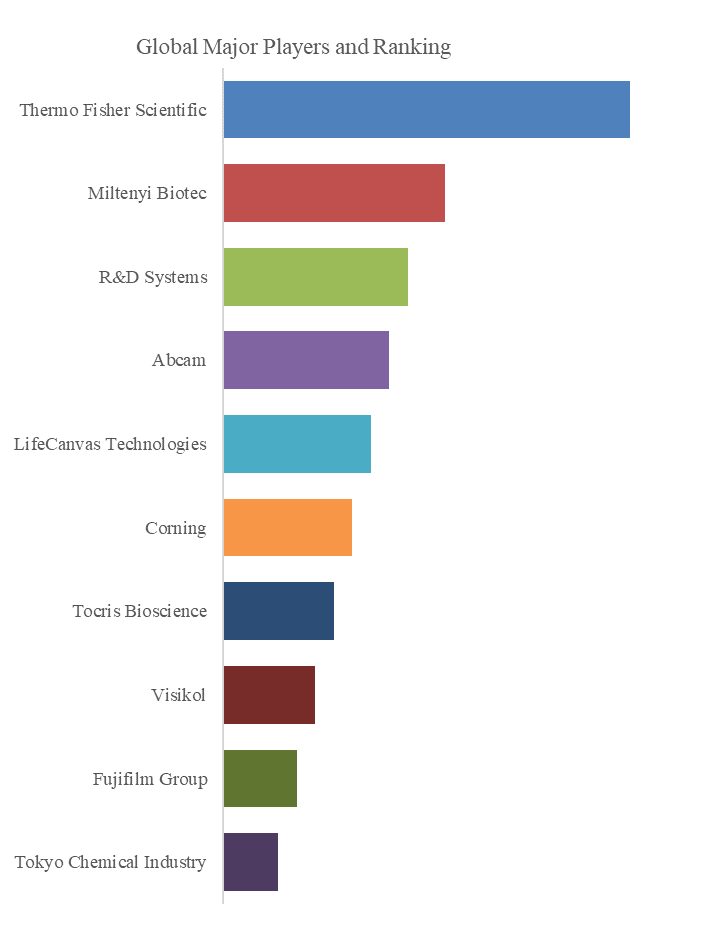
Global 3D Cell Culture Clearing Reagent Top 10 Players Ranking and Market Share
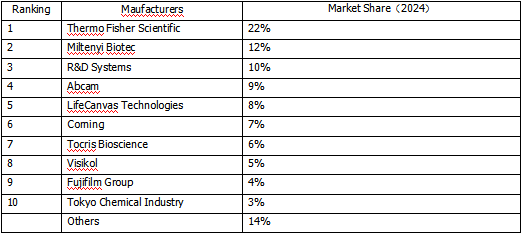
According to Global Info Research Top Players Research Center, the global key manufacturers of 3D Cell Culture Clearing Reagent include Thermo Fisher Scientific, Miltenyi Biotec, R&D Systems, Abcam, etc. In 2024, the global top four players had a share approximately 53.0% in terms of revenue.
Market Landscape Analysis Summary
Giants and innovators coexist: The market landscape reflects a typical phenomenon in the life sciences field: conglomerates and agile, innovative specialist companies (LifeCanvas, Visikol) jointly drive technological development and market expansion.
Technology is the core barrier: While giants have channel advantages, specialist companies have built strong moats with their patented chemical formulations, optimized experimental procedures, and professional technical support.
The market is not yet fully formed: Over 14% of the market share is held by "other manufacturers," indicating that this is still a dynamic emerging market with new entrants and technological approaches constantly emerging.
Top 3 Manufacturers Introduction
Thermo Fisher Scientific
Thermo Fisher Scientific, a leading global provider of scientific services, encompasses four core business areas: life sciences, clinical diagnostics, analytical instruments, and laboratory products and services. In the field of 3D Cell Culture Clearing Reagents, Thermo Fisher integrates its brands such as Invitrogen and Gibco to offer a full range of tissue clearing solutions, including ScaleS, CUBIC, and SeeDB. Its patented ScaleA2 reagent enables deep clearing of samples up to 1.5 cm thick while retaining over 95% of fluorescent protein signals and is compatible with various imaging platforms, including light sheet microscopy and confocal microscopy. This reagent system has been successfully applied in a Harvard University brain science research project, contributing to the mapping of the mouse brain's neural connectivity. Thermo Fisher also integrates its clearing reagents with the Electron Microscopy sample preparation system and the CellInsight high-content screening platform to provide end-to-end solutions for organoid drug screening and tumor microenvironment research, achieving a certain market penetration rate among top research institutions and pharmaceutical companies worldwide.
Miltenyi Biotec

Miltenyi Biotec, a leading global biotechnology and medical device company, focuses its core business on cell isolation, cell analysis, and cell manufacturing. In the field of 3D Cell Culture Clearing Reagents, the company leverages its patented MACS® Tissue Optics technology platform to develop a series of reagents with optical-grade transparency efficiency and biocompatibility. Its tissue clearing kit, using a unique aqueous formulation, achieves deep clearing of adult mouse brains within 7 days while maintaining over 92% integrity of cell nuclear antigens, and supports synergistic use with RNAscope multiplex fluorescence in situ hybridization technology. By combining clearing technology with single-cell sequencing sample preparation protocols, Miltenyi Biotec provides a complete workflow solution for cancer immunotherapy and neurodegenerative disease research, from sample pretreatment to space biology analysis.
R&D Systems
R&D Systems is a leading global supplier of cell biology research reagents, with core businesses encompassing recombinant proteins, antibodies, ELISA kits, and cell function analysis products. In the field of 3D Cell Culture Clearing Reagents, R&D Systems, leveraging its deep expertise in cell signaling research, has developed a series of reagents that combine excellent clearing performance with biomolecular preservation capabilities. This reagent system has achieved technological synergy with R&D Systems' Phospho-antibody product line, successfully enabling three-dimensional imaging of Hippo pathway activity in organoids during tumor microenvironment research at Stanford University. By combining transparency technology with cytokine detection protocols, R&D Systems provides researchers with a complete solution from 3D sample preparation to spatial resolution of signaling pathways, becoming an important technological platform for tumor immunology and developmental biology research.
Industry Chain (Upstream & Downstream) Analysis
By 2024, the global supply chain for 3D Cell Culture Clearing Reagent had taken clear shape. Its upstream is primarily dominated by international chemical and life science giants, including Merck providing key detergents and urea, Thermo Fisher Scientific supplying hydrogel monomers and antibodies, Fujifilm and Guangquan Pharmaceutical providing high-purity organic solvents, and Takara Bio providing specialized refractive index matching reagents. Downstream customers are concentrated in top research institutions and innovative pharmaceutical companies. For example, Harvard University/Wyss Institute uses it for mapping brain organoid development, Genentech integrates it into its tumor organoid drug permeability screening platform, and stem cell therapy companies use it to assess the maturity of engineered tissues. The current supply chain exhibits a trend towards "technology-driven" and "customized services." Leading suppliers are transforming from single raw material providers into partners offering complete and transparent solutions. The stability of regional supply chains and optimized formulations for specific organoid models are becoming key factors determining the efficiency of downstream research and development.
Market Dynamics
3D Cell Culture Clearing Reagent Industry Trends
1. High-Throughput End-to-End Integrated Solutions
3D Cell Culture Clearing Reagents are evolving from single reagent products to integrated workflow solutions. Leading manufacturers are launching reagent kits compatible with automated liquid handling systems and deeply integrating them with high-content imaging platforms and AI image analysis software.
2. Multi-omics Compatibility and Molecular Preservation Technology Innovation
Next-generation reagents focus on solving the challenge of biomolecular degradation during the clearing process. Reagents based on novel hydrogel immobilization technology can achieve tissue clearing while retaining more than 95% of RNA integrity and protein antigenicity.
3. Specialized Reagents and Standardized System Development
Specialized reagents for different tissue types and research needs are rapidly developing. In addition to general brain tissue clearing reagents, specialized formulations for tumor organoids, embryonic tissues, and plant samples have emerged. Simultaneously, the industry is establishing standardized evaluation systems, including quantitative indicators of transparency, fluorescence retention standards, and biocompatibility certification, driving the upgrade of reagent quality from "laboratory level" to "pharmaceutical industry level" and accelerating the standardization process of preclinical research.
3D Cell Culture Clearing Reagent Industry Development Opportunities
1. A Paradigm Shift in 3D Disease Model Research: Traditional 2D cell models differ significantly from the real in vivo microenvironment, resulting in over 70% of preclinical research data failing to translate effectively. The 3D organoid and organ-on-a-chip market is growing at over 25% annually, driving demand for deep structural observation. Transparency technology enables researchers to precisely quantify the spatial arrangement of cells, vascular network formation, and drug penetration gradients within organoids, promoting their application in cancer research and neuroscience.
2. Imaging Technology Revolution and Breakthroughs in Analytical Methods: The installation volume of light-sheet microscopes is growing by 40% annually, and their high-speed 3D imaging capabilities require transparent samples. AI image analysis platforms enable automatic cell segmentation and spatial statistics, extracting over 200 morphological parameters in a single experiment.
3. The Urgent Need to Improve Drug Development Efficiency: The pharmaceutical industry faces pressure from continuously declining R&D returns; 3D models can improve the accuracy of preclinical predictions. Drug penetration studies using transparency technology reduce the failure rate of candidate compound screening. Regulatory agencies are beginning to accept 3D model data as supporting material for IND applications, further promoting the standardized application of this technology in the drug development process.
3D Cell Culture Clearing Reagent Industry Restraints
1. Technical Complexity and Lack of Standardization
Current transparency techniques involve multi-step procedures, including key steps such as sample fixation, permeation, destaining, and refractive index matching. Over 20 variations exist in transparency protocols across different laboratories, making direct comparison of results difficult. The lack of unified quantitative standards for transparency and a fluorescence retention rate assessment system severely hinders the reliability and reproducibility of research findings.
2. Sample Compatibility and Information Loss Challenges
Existing reagents show significant differences in performance across different tissue types, particularly with adipose tissue and bone. Transparency processes result in an average of 15%-30% fluorescence signal attenuation, and the preservation efficiency for biomolecules such as RNA and proteins is less than 50%. This information loss poses significant technical challenges to subsequent spatial multi-omics analysis, limiting the multidimensional utilization value of the data.
3. Equipment Dependence and Cost Pressures
High-quality transparency imaging relies on specialized equipment such as light-sheet microscopes, with a single system costing between $500,000 and $2 million. A typical laboratory requires an initial investment exceeding $300,000 to conduct complete transparency research, with reagent costs accounting for 25%-40% of the annual budget. This high barrier to entry excludes most small and medium-sized research institutions, significantly restricting the speed of technology dissemination and the scope of its application.
Chapter 1, to describe 3D Cell Culture Clearing Reagent product scope, market overview, market estimation caveats and base year.
Chapter 2, to profile the top manufacturers of 3D Cell Culture Clearing Reagent, with price, sales quantity, revenue, and global market share of 3D Cell Culture Clearing Reagent from 2021 to 2025.
Chapter 3, the 3D Cell Culture Clearing Reagent competitive situation, sales quantity, revenue, and global market share of top manufacturers are analyzed emphatically by landscape contrast.
Chapter 4, the 3D Cell Culture Clearing Reagent breakdown data are shown at the regional level, to show the sales quantity, consumption value, and growth by regions, from 2021 to 2032.
Chapter 5 and 6, to segment the sales by Type and by Application, with sales market share and growth rate by Type, by Application, from 2021 to 2032.
Chapter 7, 8, 9, 10 and 11, to break the sales data at the country level, with sales quantity, consumption value, and market share for key countries in the world, from 2021 to 2025.and 3D Cell Culture Clearing Reagent market forecast, by regions, by Type, and by Application, with sales and revenue, from 2026 to 2032.
Chapter 12, market dynamics, drivers, restraints, trends, and Porters Five Forces analysis.
Chapter 13, the key raw materials and key suppliers, and industry chain of 3D Cell Culture Clearing Reagent.
Chapter 14 and 15, to describe 3D Cell Culture Clearing Reagent sales channel, distributors, customers, research findings and conclusion.
For more information, please refer to "Global 3D Cell Culture Clearing Reagent Market 2025 by Manufacturers, Regions, Type and Application, Forecast to 2031". This report analyzes the supply and demand situation, development status, and changes in the industry, focusing on the development status of the industry, how to face the development challenges of the industry, industry development suggestions, industry competitiveness, and industry investment analysis and trend forecasts. The report also summarizes the overall development dynamics of the industry, including the impact of the latest US tariffs on the global supply chain, the supply relationship analysis of the industrial chain, and provides reference suggestions and specific solutions for the industry in terms of products.
About Us
Global info Research is a report publisher that focuses on collecting global industry information, mainly providing market strategy analysis for enterprises and helping users understand industry development opportunities. It focuses on industry research, market share analysis, market share, customized research, corporate strategic planning, industry chain research, database analysis and top industry survey services. The market research reports published by Global info Research are trusted by more than 30,000 companies. It provides analytical report support for enterprises in the market competition landscape and assists enterprises in making wise investment decisions.
Contact Us
Global Info Research
Web: https://www.globalinforesearch.com
Email: report@globalinforesearch.com
Share on Social Media



Other Industry News
Ready to start publishing
Sign Up today!